


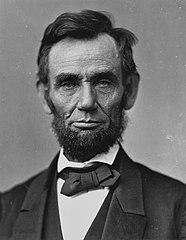
"It was decided that we have a case of rebellion, and that the public safety does require the qualified suspension of the privilege of the writ which was authorized to be made."
- Abraham Lincoln, Message to Congress in Special Session (1861)
Guiding Questions:
- Read the clauses of Article I and Article II below and explain how these clauses reflect the concepts of separation of powers and shared powers.
- Using evidence from his message to Congress, explain how Lincoln justifies suspending habeas corpus.
- Focusing on his message to Congress and letter to Corning, compare and contrast Lincoln's justifications for suspending habeas corpus.
- The excerpt from Story's commentary argues that the suspension of habeas corpus is under the purview of Congress. Write a response to Story's reasoning from Lincoln's perspective.
- Read through the excerpts from the cases of Milligan and Vallandingham. To what extent did these cases represent an abuse of executive power? Describe the constitutional implications of a President refusing to abide by a Supreme Court decision.
The Privilege of the Writ of Habeas Corpus shall not be suspended, unless when in Cases of Rebellion or Invasion the public Safety may require it.
The President shall be Commander in Chief of the Army and Navy of the United States, and of the Militia of the several States, when called into the actual Service of the United States; he may require the Opinion, in writing, of the principal Officer in each of the executive Departments, upon any Subject relating to the Duties of their respective Offices, and he shall have Power to Grant Reprieves and Pardons for Offences against the United States, except in Cases of Impeachment.
Soon after the first call for militia, it was considered a duty to authorize the Commanding General, in proper cases, according to his discretion, to suspend the privilege of the writ of habeas corpus; or, in other words, to arrest, and detain, without resort to the ordinary processes and forms of law, such individuals as he might deem dangerous to the public safety. This authority has purposely been exercised but very sparingly. Nevertheless, the legality and propriety of what has been done under it, are questioned; and the attention of the country has been called to the proposition that one who is sworn to “take care that the laws be faithfully executed,” should not himself violate them. Of course some consideration was given to the questions of power, and propriety, before this matter was acted upon. The whole of the laws which were required to be faithfully executed, were being resisted, and failing of execution, in nearly one-third of the States. Must they be allowed to finally fail of execution, even had it been perfectly clear, that by the use of the means necessary to their execution, some single law, made in such extreme tenderness of the citizen’s liberty, that practically, it relieves more of the guilty, than of the innocent, should, to a very limited extent, be violated? To state the question more directly, are all the laws, but one, to go unexecuted, and the government itself go to pieces, lest that one be violated? Even in such a case, would not the official oath be broken, if the government should be overthrown, when it was believed that disregarding the single law, would tend to preserve it? But it was not believed that this question was presented. It was not believed that any law was violated. The provision of the Constitution that “The privilege of the writ of habeas corpus, shall not be suspended unless when, in cases of rebellion or invasion, the public safety may require it,” is equivalent to a provision—is a provision—that such privilege may be suspended when, in cases of rebellion, or invasion, the public safety does require it. It was decided that we have a case of rebellion, and that the public safety does require the qualified suspension of the privilege of the writ which was authorized to be made. Now it is insisted that Congress, and not the Executive, is vested with this power. But the Constitution itself, is silent as to which, or who, is to exercise the power; and as the provision was plainly made for a dangerous emergeny, it cannot be believed the framers of the instrument intended, that in every case, the danger should run its course, until Congress could be called together; the very assembling of which might be prevented, as was intended in this case, by the rebellion.
Now, therefore, I, Abraham Lincoln, President of the United States, do hereby proclaim and make known to all whom it may concern that the privilege of the writ of habeas corpus is suspended throughout the United States in the several cases before mentioned, and that this suspension will continue throughout the duration of the said rebellion or until this proclamation shall, by a subsequent one to be issued by the President of the United States, be modified or revoked. And I do hereby require all magistrates, attorneys, and other civil officers within the United States and all officers and others in the military and naval services of the United States to take distinct notice of this suspension and to give it full effect, and all citizens of the United States to conduct and govern themselves accordingly and in conformity with the Constitution of the United States and the laws of Congress in such case made and provided.
It is obvious, that cases of a peculiar emergency may arise, which may justify, nay even require, the temporary suspension of any right to the writ. But as it has frequently happened in foreign countries, and even in England, that the writ has, upon various pretexts and occasions, been suspended, whereby persons apprehended upon suspicion have suffered a long imprisonment, sometimes from design, and sometimes, because they were forgotten, the right to suspend it is expressly confined to cases of rebellion or invasion, where the public safety may require it. A very just and wholesome restraint, which cuts down at a blow a fruitful means of oppression, capable of being abused in bad times to the worst of purposes. Hitherto no suspension of the writ has ever been authorized by congress since the establishment of the constitution. It would seem, as the power is given to congress to suspend the writ of habeas corpus in cases of rebellion or invasion, that the right to judge, whether exigency had arisen, must exclusively belong to that body.
Time has proven the discernment of our ancestors. . . . Those great and good men foresaw that troublous times would arise when rulers and people would become restive under restraint, and seek by sharp and decisive measures to accomplish ends deemed just and proper, and that the principles of constitutional liberty would be in peril unless established by irrepealable law. The history of the world had taught them that what was done in the past might be attempted in the future. The Constitution of the United States is a law for rulers and people, equally in war and in peace, and covers with the shield of its protection all classes of men, at all times and under all circumstances. No doctrine involving more pernicious consequences was ever invented by the wit of man than that any of its provisions can be suspended during any of the great exigencies of government. Such a doctrine leads directly to anarchy or despotism, but the theory of necessity on which it is based is false, for the government, within the Constitution, has all the powers granted to it which are necessary to preserve its existence, as has been happily proved by the result of the great effort to throw off its just authority.
The specification under the charge was that he, the said Vallandigham, a citizen of Ohio, on the 1st of May, 1863, at Mount Vernon in Knox County, Ohio, did publicly address a large meeting of persons, and did utter sentiments, in words or to the effect, "that the present war was a wicked, cruel, and unnecessary war, one not waged for the preservation of the Union, but for the purpose of crushing out liberty and to erect a despotism; a war for the freedom of the blacks and the enslavement of the whites; and that if the administration had not wished otherwise, that the war could have been honorably terminated long ago; that peace might have been honorably made by listening to the proposed intermediation of France; that propositions, by which the Southern states could be won back, and the South guaranteed their rights under the Constitution, had been rejected the day before the late battle of Fredericksburg by Lincoln and his minions, meaning the President of the United States, and those under him in authority. Also charging that the government of the United States was about to appoint military marshals in every district to restrain the people of their liberties, and to deprive them of their rights and privileges, characterizing General Order No. 38, from headquarters of the Department of the Ohio, as a base usurpation of arbitrary authority, inviting his hearers to resist the same, by saying, the sooner the people inform the minions of usurped power that they will not submit to such restrictions upon their liberties, the better; and adding, that he was at all times and upon all occasions resolved to do what he could to defeat the attempts now being made to build up a monarchy upon the ruins of our free government, and asserting that he firmly believed, as he had said six months ago, that the men in power are attempting to establish a despotism in this country, more cruel and oppressive than ever existed before."
Whatever may be the force of Vallandigham's protest, that he was not triable by a court of military commission, it is certain that his petition cannot be brought within the 14th section of the act, and further that the court cannot, without disregarding its frequent decisions and interpretation of the Constitution in respect to its judicial power, originate a writ of certiorari to review or pronounce any opinion upon the proceedings of a military commission. It was natural, before the sections of the 3d article of the Constitution had been fully considered in connection with the legislation of Congress, giving to the courts of the United States power to issue writs of scire facias, habeas corpus, and all other writs not specially provided for by statute, which might be necessary for the exercise of their respective jurisdiction, that by some members of the profession it should have been thought, and some of the early judges of the Supreme Court also, that the 14th section of the act of 24th September, 1789, gave to this Court a right to originate processes of habeas corpus ad subjiciendum, writs of certiorari to review the proceedings of the inferior courts as a matter of original jurisdiction, without being in any way restricted by the constitutional limitation, that in all cases affecting ambassadors, other public ministers and consuls, and those in which a state shall be a party, the Supreme Court shall have original jurisdiction. This limitation has always been considered restrictive of any other original jurisdiction. The rule of construction of the Constitution being that affirmative words in the Constitution declaring in what cases the Supreme Court shall have original jurisdiction must be construed negatively as to all other cases.ad subjiciendum have been fully discussed by this Court at different times. We do not think it necessary, however, to examine or cite many of them at this time. We will annex a list to this opinion, distinguishing what this Court's action has been in cases brought to it by appeal from such applications as have been rejected, when it has been asked that it would act upon the matter as one of original jurisdiction. In the case Ex Parte Milburn,In re Kaine,Ex Parte Metzger,Metzger's Case had been made upon the ground that the proceeding of the district judge was not judicial in its character, but that the proceedings of the military commission were so, and further it was said that the ruling in that case had been overruled by a majority of the judges in Raines' Case. There is a misapprehension of the report of the latter case, and as to the judicial character of the proceedings of the military commission, we cite what was said by this Court in the case of United States v. Ferreira.
It may be remarked: First, that we had the same constitution then, as now. Secondly, that we then had a case of Invasion, and that now we have a case of Rebellion, and: Thirdly, that the permanent right of the people to public discussion, the liberty of speech and the press, the trial by jury, the law of evidence, and the Habeas Corpus, suffered no detriment whatever by that conduct of Gen. Jackson, or it's subsequent approval by the American congress.
And yet, let me say that in my own discretion, I do not know whether I would have ordered the arrest of Mr. V. While I can not shift the responsibility from myself, I hold that, as a general rule, the commander in the field is the better judge of the necessity in any particular case. Of course I must practice a general directory and revisory power in the matter.
The next clause is, “The privilege of the writ of habeas corpus shall not be suspended, unless when, in cases of rebellion or invasion, the public safety may require it.”
The application in this case for a writ of habeas corpus is made to me under the 14th section of the Judiciary Act of 1789, which renders effectual for the citizen the Constitutional privilege of the writ of habeas corpus. That act gives to the courts of the United States, as well as to each Justice of the Supreme Court, and to every District Judge, power to grant writs of habeas corpus for the purpose of an inquiry into the cause of commitment. The petition was presented to me at Washington under the impression that I would order the prisoner to be brought before me there, but as he was confined in fort McHenry, at the city of Baltimore, which is in my circuit, I resolved to hear it in the latter city, as obedience to the writ, under such circumstances, would not withdraw General Cadwallader, who had him in charge, from the limits of his military command.