


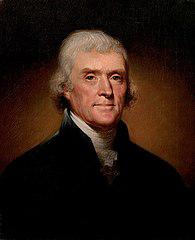
"I know that the acquisition of Louisiana has been disapproved by some, from a candid apprehension that the enlargement of our territory would endanger its union."
- Thomas Jefferson, March 4, 1805 Second Inaugural Address
Guiding Questions:
- Explain Jefferson's rationale for purchasing the Louisiana territory. Does his reasoning align with the language of Article IV?
- Read the excerpt from Story's commentary, and using evidence from the text, describe how Jefferson would interpret Story's notion of a "common benefit" to the country.
- Read Justice Curtis' dissent from Dred Scott v. Sandford. Using examples from American history, what exactly was the relationship between territorial expansion and the Constitution? What role does Congress play when annexing territory?
New States may be admitted by the Congress into this Union; but no new State shall be formed or erected within the Jurisdiction of any other State; nor any State be formed by the Junction of two or more States, or Parts of States, without the Consent of the Legislatures of the States concerned as well as of the Congress.
I know that the acquisition of Louisiana has been disapproved by some, from a candid apprehension that the enlargement of our territory would endanger its union.
But who can limit the extent to which the federative principle may operate effectively? The larger our association, the less will it be shaken by local passions; and in any view, is it not better that the opposite bank of the Mississippi should be settled by our own brethren and children, than by strangers of another family? With which shall we be most likely to live in harmony and friendly intercourse? In matters of religion, I have considered that its free exercise is placed by the constitution independent of the powers of the general government.
Should the acquisition of Louisiana be constitutionally confirmed and carried into effect, a sum of nearly thirteen millions of dollars will then be added to our public debt, most of which is payable after fifteen years; before which term the present existing debts will all be discharged by the established operation of the sinking fund.
Still this did not content them. Under the lead of Hancock and Samuel Adams, of Patrick Henry and George Mason, they demanded an explicit declaration that no more power was to be exercised than they had delegated. And the Ninth and Tenth Amendments to the Constitution were designed to include the reserved rights of the States, and the people, within all the sanctions of that instrument, and to bind the authorities, State and Federal, by the judicial oath it prescribes, to their recognition and observance. Is it probable, therefore that the supreme and irresponsible power, which is now claimed for Congress over boundless territories, the use of which cannot fail to react upon the political system of the States, to its subversion, was ever within the contemplation of the statesmen who conducted the counsels of the people in the formation of this Constitution? When [p512] the questions that came to the surface upon the acquisition of Louisiana were presented to the mind of Jefferson, he wrote:
I had rather ask an enlargement of power from the nation, where it is found necessary, than to assume it by a construction which would make our powers boundless. Our peculiar security is in the possession of a written Constitution. Let us not make it blank paper by construction. I say the same as to the opinion of those who consider the grant of the treaty-making power as boundless. If it is, then we have no Constitution. If it has bounds, they can be no others than the definitions of the powers which that instrument gives. It specifies and delineates the operations permitted to the Federal Government, and gives the powers necessary to carry them into execution.
At the time, when the preliminary measures were taken for the admission of the state of Missouri into the Union, an attempt was made to include a restriction, prohibiting the introduction of slavery into that state, as a condition of the admission. On that occasion the question was largely discussed, whether congress possessed a constitutional authority to impose such a restriction, upon the ground, that the prescribing of such a condition is inconsistent with the sovereignty of the state to be admitted, and its equality with the other states. The final result of the vote, which authorized the erection of that state, seems to establish the rightful authority of congress to impose such a restriction, although it was not then applied. In the act passed for this purpose, there is an express clause, that in all the territory ceded by France to the United States under the name of Louisiana, which lies north of 360 30′ N. Lat., not included within the limits of the state of Missouri, slavery and involuntary servitude, otherwise than in the punishment of crimes, whereof the parties shall have been duly convicted, shall be, and is hereby for ever prohibited. An objection of a similar character was taken to the compact between Virginia and Kentucky upon the ground, that it was a restriction upon state sovereignty. But the Supreme Court had no hesitation in overruling it, considering it as opposed by the theory of all free governments, and especially of those, which constitute the American Republics.
What a strange representation is this of a republican government, created by, and responsible to, the people in all its departments! What possible analogy can there be between the possession of large revenues in the hands of a monarch, and large revenues in the possession of a government, whose administration is confided to the chosen agents of the people for a short period, and may be dismissed almost at pleasure? If the doctrine be true, which is here inculcated, a republican government is little more than a dream, however its administration may be organized; and the people are not worthy of being trusted with large public revenues, since they cannot provide against corruption, and abuses of them. Poverty alone (it seems) gives a security for fidelity; and the liberties of the people are safe only, when they are pressed into vigilance by the power of taxation. In the view of this doctrine, what is to be thought of the recent purchases of Louisiana and Florida? If there was danger before, how mightily must it be increased by the accession of such a vast extent of territory, and such a vast increase of resources? Hitherto, the experience of the country has justified no alarms on this subject from such a source. On the other hand, the public lands hold out, after the discharge of the national debt, ample revenues to be devoted to the cause of education and sound learning, and to internal improvements, without trenching upon the property, or embarrassing the pursuits of the people by burthensome taxation. The constitutional objection to the appropriation of the other revenues of the government to such objects has not been supposed to apply to an appropriation of the proceeds of the public lands. The cessions of that territory were expressly made for the common benefit of the United States; and therefore constitute a fund, which may be properly devoted to any objects, which are for the common benefit of the Union.
New States may be admitted by the Congress into this Union; but no new State shall be formed or erected within the Jurisdiction of any other State; nor any State be formed by the Junction of two or more States, or Parts of States, without the Consent of the Legislatures of the States concerned as well as of the Congress.
The judicial Power shall extend to all Cases, in Law and Equity, arising under this Constitution, the Laws of the United States, and Treaties made, or which shall be made, under their Authority;—to all Cases affecting Ambassadors, other public ministers and Consuls;—to all Cases of admiralty and maritime Jurisdiction;—to Controversies to which the United States shall be a Party;—to Controversies between two or more States;—between a State and Citizens of another State;—between Citizens of different States;—between Citizens of the same State claiming Lands under Grants of different States, and between a State, or the Citizens thereof, and foreign States, Citizens or Subjects.