


Articles of Confederation
The Articles of Confederation, our first form of government (1781-1789), are generally considered a failure; a weak and ineffective system saved by the Constitution. However, this exercise will examine two of its positive achievements and legacies. Specifically, you will examine the Land Ordinance of 1785 and the Northwest Ordinance (1787) enacted by the Articles.
I. Land Ordinance
The national government needed to organize the new territory north of the Ohio River. Therefore, in 1785 it enacted the Northwest Ordinance.
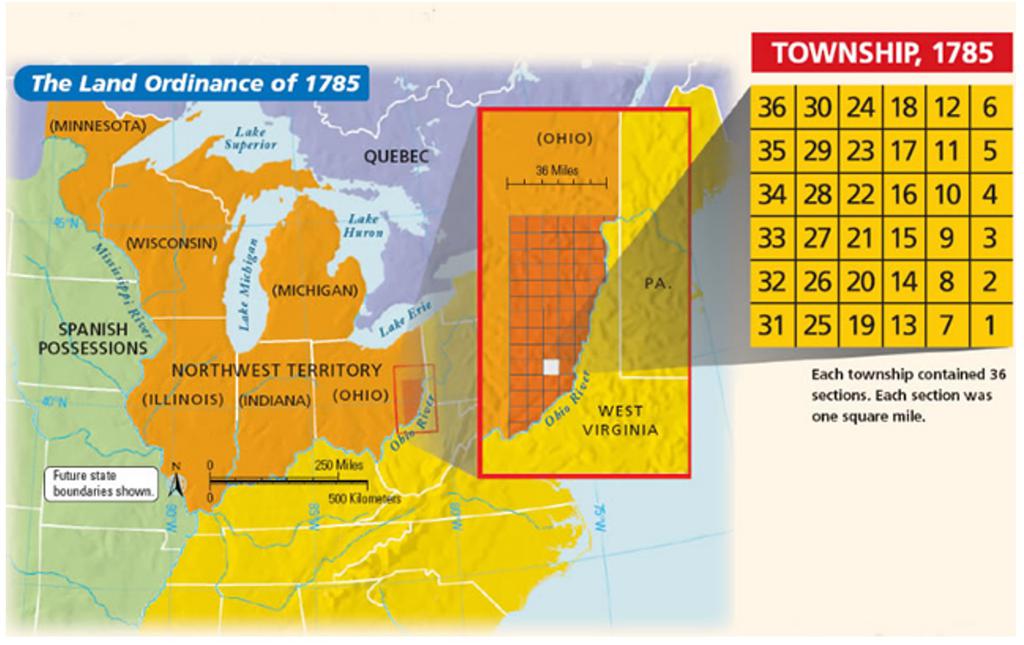
Some important provisions of the Land Ordinance:
•Townships were self-governing (equivalent to cities today)
•Each section had 640 acres
•Sections were sold by the federal government to buyers for $1.00
per acre (but you had to buy a minimum of 640 acres!)
•Section 16 was reserved for education
•Five other sections were reserved for public or government
functions.
Questions:
1. What do you see as the virtue of surveying the land on a grid system
into square mile units?
2. Why was section 16, in particular, reserved for education?
3. How did land sales benefit the federal government? Do you think
the $640 minimum was a good policy?
4. How would the creation of townships promote local self-government
and democratic values?
5. How is the American system of government moving a different direction from European ones?
II. Northwest Ordinance:
A. Watch short video on the Northwest Ordinance
https://www.youtube.com/watch?v=Zvn_s3PPLoA&ab_channel=NBCNewsLearn
Question:
Why do you think it was important to allow the territories to come into the union as states equal to the original 13? (In other words, they don’t come in as junior partners or second-class states)
Primary Source Analysis: Northwest Ordinance (July 13, 1787)
Section 14:
Article 1: No person… shall ever be molested [attacked or persecuted] on account of his mode of worship or religious sentiments, in the said territory.
Article 2: The inhabitants of the said territory shall always be entitled to the benefits of the writ of habeas corpus [to be informed of the charges if arrested or detained for any reason], and of the trial by jury. .. and of judicial proceedings according to the course of the common law.
All persons shall be bailable, unless for capital offenses [murder], where the proof shall be evident or the presumption great. All fines shall be moderate; and no cruel or unusual punishments shall be inflicted. No man shall be deprived of his liberty or property, but by the judgment of his peers or the law of the land [jury trial]
Article 3: Religion, morality, and knowledge, being necessary to good government and the happiness of mankind, schools and the means of education shall forever be encouraged. The utmost good faith shall always be observed towards the Indians; their lands and property shall never be taken from them without their consent; and, in their property, rights, and liberty, they shall never be invaded or disturbed, unless in just and lawful wars authorized by Congress; but laws founded in justice and humanity, shall from time to time be made for preventing wrongs being done to them, and for preserving peace and friendship with them.
Article 6: There shall be neither slavery nor involuntary servitude in the said territory, otherwise than in the punishment of crimes whereof the party shall have been duly convicted
Questions:
1. Why did they add a provision for religious toleration
2. List 3 civil rights guaranteed to the inhabitants.
3. How did it envision the relationship with Native Americans? Do you
see anything in the provision that might change it?
4. What do you see at the significance of Article 6?
5. Looking ahead, can you see how the Northwest Ordinance will create
a region culturally and socially different from the South?