


For some time now, commentators and journalists have constantly been telling us, to the effect, that “politics have never been this nasty,” “we have never been this divided” and “in the old days there were strict boundaries that candidates would not cross.” However, revisiting the election of 1828, nearly 200 years ago, reveals this is hardly the case. In this exercise you will look at this famous contest as well as its historical context in order to understand the roots of political polarization and how it has shaped our modern campaigns.
I: Rise of the Common Man
Background
In the nation’s first elections during the 1790s, candidates for office did not directly ask for votes, but rather “stood” for office. There was an old saying that ‘the man does not seek the office” but rather “the office seeks the man.” In other words, the office seeker must appear to be above politics. Political parties were considered dangerous and divisive. In his 1796 Farewell Address, President George Washington warned his countrymen against them. Not surprisingly, when factions (the Federalists and the Democratic-Republicans) emerged during the 1790’s, both denied they were parties! To actively campaign and openly solicit votes was considered not only in bad taste, but a threat to the republic. However, these ideas about elections and campaigning would change by 1820s.
Trace the rise of the common man and the democratization of politics by analyzing the three paintings:
A. Walter Tittle, “Lady Washington’s Levee” [reception hosted by
President and Martha Washington in Philadelphia during the early
1790s]
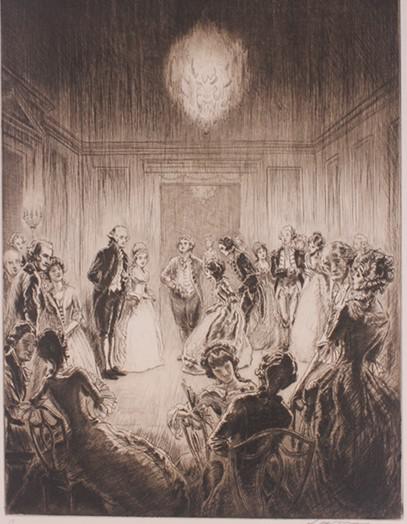
1. What do you notice about the guests?
2. What do you notice about the Washington’s position in relation to
them?
3. What is significant about the setting?
B. George Bingham, “The Country Politician” (1849)
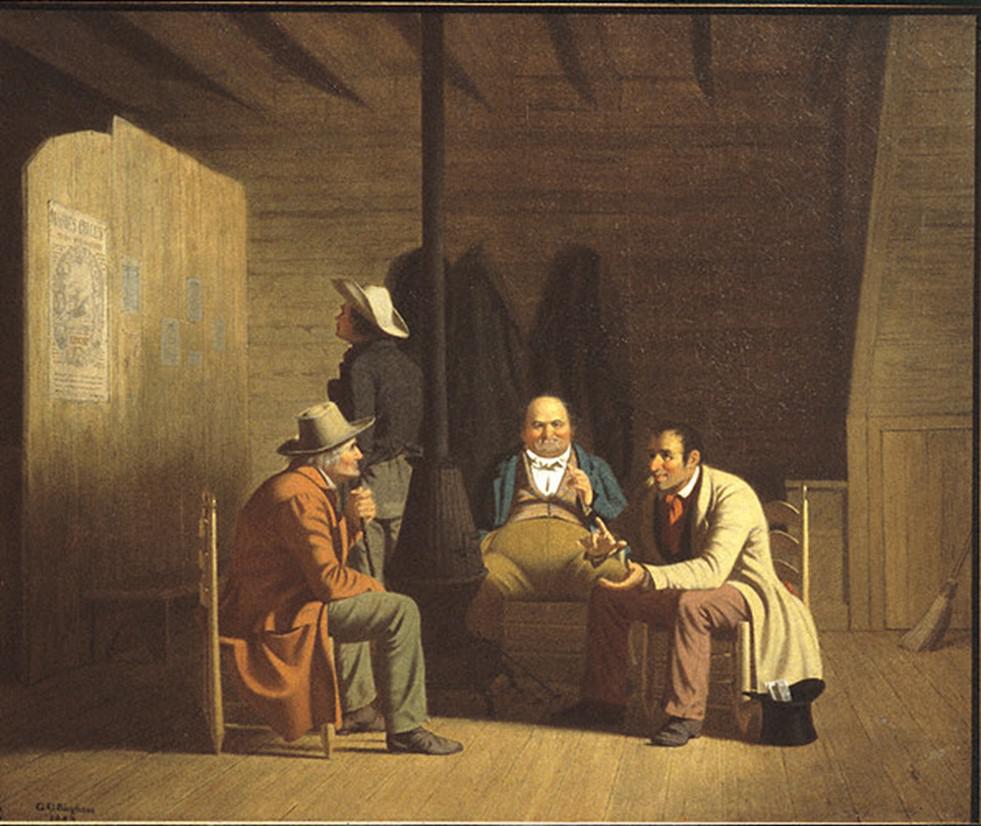
1. Pick out details in the painting that reflect how politics is changing.
2. Who might each of the characters represent?
3. What is the significance of the setting?
4. Which one is the politician?
C. George Bingham, “Stump Speaking” (1856)
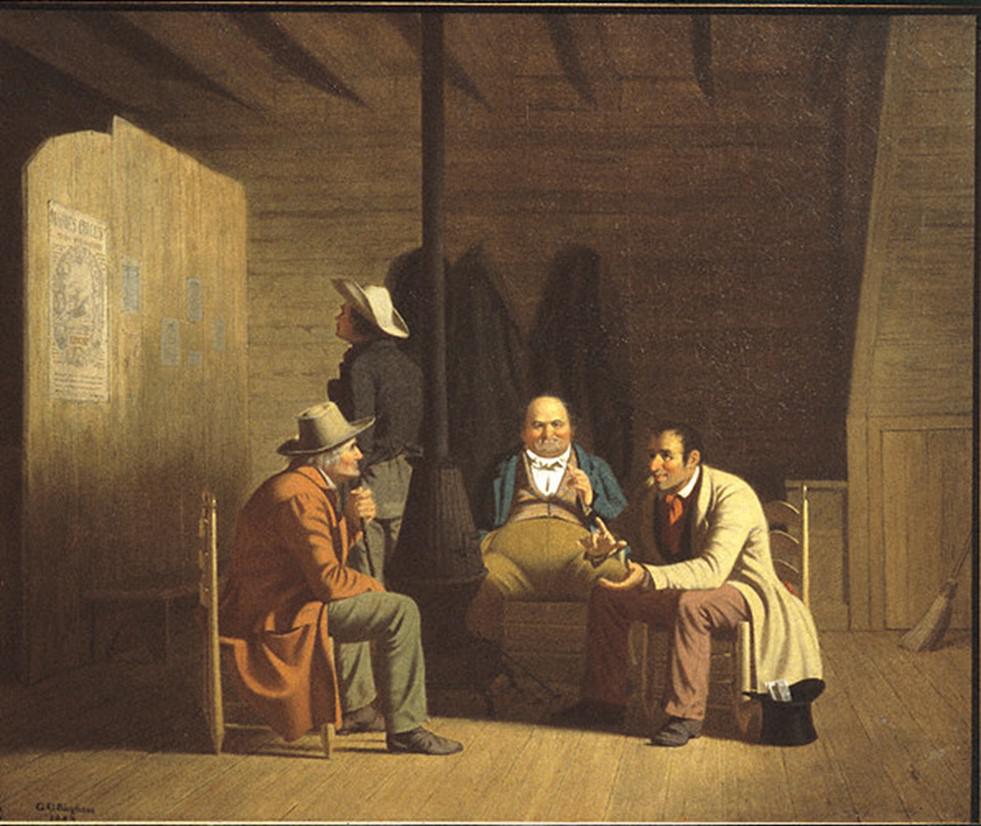
1. What is the significance of the setting?
2. What do you notice about the participants?
3. Explain the changes in politics from the first painting to the second
two.
II: Watch the overview of the 1828 election:
1. What did the narrator mean by: “In this election the truth hardly
mattered.” Provide some specific examples.
2. What were some the accusations leveled by the Jackson and Adams
camps?
III. Secondary Source Analysis: Personal attacks and the Election of
1828
The Adamsites [supporters of John Quincy Adams] did excel in one area, the dark art of political slander [smears]. In 1827, a Cincinnati editor and friend of [Henry] Clay’s named Charles Hammond took a fact finding tour into Kentucky and Tennessee, and unearthed some old stories about alleged legal irregularities in Jackson's marriage (supposedly he was a bigamist [someone married to more than one person]), along with the charges that Jackson's wife, Rachel, was an adulteress [unfaithful spouse} and his mother a common prostitute. These charges were not simply mean spirited: they evoked broader cultural presumptions that stigmatized [branded] Jackson as a boorish [rude], lawless, frontier lowlife, challenging the Christian gentleman John Quincy Adams. Clay immediately recommended his mudslinger friend to [Daniel] Webster, calling Hammond’s paper “upon the whole, the most efficient and discreet [not noticeable] Gazette [newspaper] that espouses our cause” and suggested that the editor get direct financial support. Hammond, meanwhile, became a fountain of wild and inflammatory charges-that Jackson's mother had been brought to America by British soldiers, that she married in mulatto [mixed-race individual] who was Jackson's father-all of which found their way into what may have been the lowest production of the 1828 campaign, a new journal entitled Truth’s Advocate and Monthly anti Jackson Expositor. Jackson, enraged to the point of tears, held Clay responsible and sent John Eaton to confront the Kentuckian. Clay vehemently [strongly] denied the charges, though his private correspondence with Hammond contains hints that he was lying. Jackson continued to blame everything on Clay.
Sean Wilentz, The Rise of American Democracy, p. 306
1. How were the charges against Jackson discovered and made public?
2. Why did they refer to Adams as “the Christian gentleman”?
3. List 3 of the accusations against Jackson and explain which one you
think would have been the most damaging in the 1828 election.
Explain.
4. This was the first campaign in American history in which the
candidate’s wife was so directly attacked.
Do you think this was a wise political strategy? Explain
5. Does the Truth’s Advocate and Monthly anti Jackson Expositor
remind you of Twitter? Why/why not?
IV: Your Thoughts
Write a paragraph that either supports, refutes or modifies the following statement about current politics:
“Politicians are not at fault for dirty, personalized campaigns; we, the voters, are to blame for being swayed by them.”